First off, I would like to send a huge thank you to Lisa whom we met in Mexico City and talked us into visiting Easter Island, or Rapa Nui as we’ve learned is the preferred name. It was never on our itinerary for South America but we are so glad we made the trip.
We had booked our accommodations at a family run hostel and it was great. Picked us up at the airport, presented us with beautiful leis and made sure we were comfortably settled in.They even gifted us handy bags. Turned out to be very useful when we headed out for a morning of diving the next day.Being able to grab fresh bananas off the tree right outside our room for breakfast reminded me why I love island life.
We had decided to stay on the island for four nights, which worked out perfectly.
Once we knew we were coming to the island, the first thing I checked was if there was any diving there. It is the South Pacific after all.
We went with the top rated Mike Rapu Diving Centre. As we had no plans on doing any diving when we headed to South America we didn’t have our dive computers or the underwater housing for my little action camera. Truly these are the hardships we are forced to endure. We ended up doing two dives on our first full day on Rapa Nui. It was just Karen and I and the dive master. The dives were lovely, with the coral being different from what we were accustomed to and the visibility a fantastic 30 metres.
After diving we discovered the most amazing restaurant. The sushi was phenomenal and the locally caught tuna, something they are very proud of, was the best I think I have ever had. We ended up at this place three more times.I knew we would be safe here when I saw that even the chickens used the crosswalk to cross the road.
Our second full day was filled with a guided tour of the sights Easter Island is famous for. As the island is very limited in the way of work outside of tourism and fishing they make the best of it. There are only two Moai sites that you can access without a guide. You also have to purchase a 10 day Park Pass ($100USD per person) to access any of the sites. At first, I felt we were getting taken advantage of. However, between the guides with every group of tourists, the drivers, the attendants at every site, there are a lot of them, it was easy to see the positive impact of this amount of employment on such a tiny island (163 km² with around 8000 residents). And it is bloody impressive.
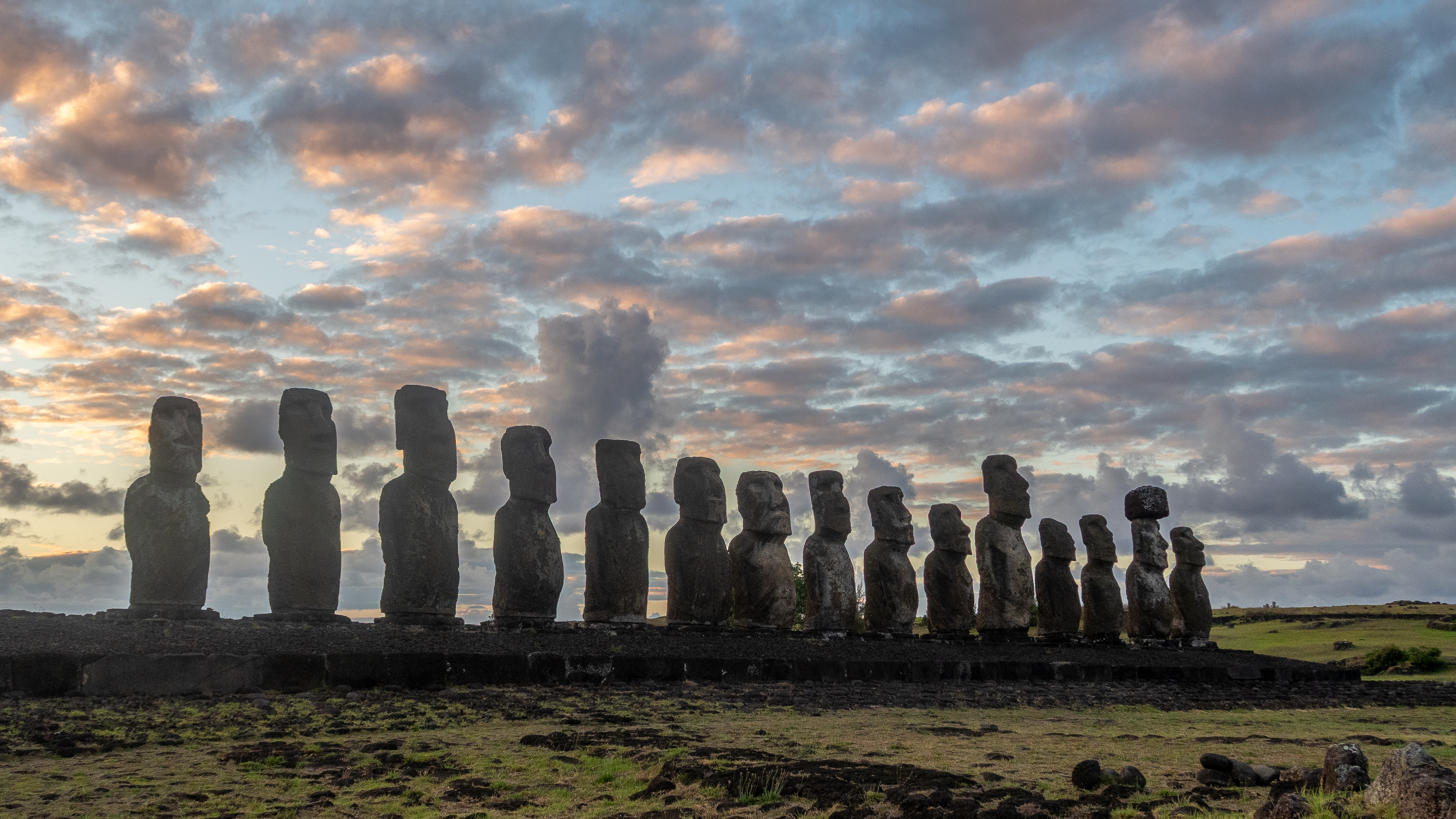
We started the day with a 5:30 pick up and 40 minute drive across the island to watch the sun rise over the 15 iconic Moai at the main ceremonial site.It was beautiful and humbling.You get an idea of the size of this Statue known as the Travelling Moai. This one was sent to Japan for an exhibition. A business man from the Taranto company (crane manufacturer) and the Japanese government were so impressed they paid for the restoration of this site.We saw a recreated rendition of an original village of the first inhabitants of the island. The houses were shaped the same as the boats they arrived in.As the island is volcanic in origin the most useable resource is rock. They built these walls to protect their crops from the ocean winds.Even the chicken coops were made entirely of stone. You can see the chickens door near the bottom left corner. Humans had to remove rocks and enter through the roof for cleaning.
We went to a bunch of sites, but after the 15 Moai, the most impressive was the quarry where the Moai were created. This quarry, Rano Raraku, is in an old volcanic crater.
Of the over 800 Moia on Rapa Nui, around 300 are found in this location.Over the 400 to 500 years that Moia were carved they got progressively taller. The theory is the procedure was to bury them so the stone masons could do the finishing touches on their neck and heads. Some unfinished Moai in the quarry were 21 metres in height.They are all carved from just one piece of rock.You have to have some fun with them.Seeing the partially carved Moai was fascinating. To see where they were cut from gives you a great insight into how they were raised and moved once it was time. Human problem solving is truly amazing.
On our last full day on the island we rented a car and simply toured around and enjoyed the island.
The crater of Rano Kau, the dormant volcano just outside of the capital Hanga Roa. There are three main dormant volcanoes on the island and around 70 smaller cones. The last eruption was tens of thousands of years ago.There are more than 300 Moai platforms across the island, which means once you are out of Hanga Roa you can often see more than one from most points near the coast. There are three in this shot. It is believed each village had their own mound.What I had no idea of was that each mound on which the Moai stand is actual a burial mound with potentially hundreds of remains below.This is a more typical view of a Moai mound. Between time, wind, tsunami and conflict pretty well all the Moai on the island were knocked over. Their Top Knots, or headgear, was the only piece added once they were moved to the final positions so they were able to roll a bit from where they started.These Moai, known as Ahu Nau Nau, at Anakena beach have been restored with their top knots in place.They also have the best surviving carvings on their backs of any on the island.It wasn’t all Moai though. We found time to relax and enjoy the two beaches on the island.There is something immensely therapeutic about looking out to sea.Or just laying back and staring at the sky. Make sure there are no coconuts right above you.Our rental for the day. It ran and we didn’t get stuck, but what a piece of junk. The climate is hard on vehicles.At its height, Rapa Nui is estimated to have had 10’s of thousands of inhabitants which helps to explain the huge numbers of Moai mounds all over the island. It is also believed that when the population started to outpace the available food that cannibilism was probably practiced.Typical Moai before restoration.We did come across a more modern cemetery.The islands lifeline. Though Easter Island has the longest aircraft landing strip in the South Pacific, most of its supplies come in by container ship and are shuttled into this harbour by smaller boats. Interestingly it has a small NASA facility here because their long runway is one of the alternate landing sites for the Space Shuttle should they not be able to make it to their normal landing strip.As we prepared to head to the airport we were treated to one more beautiful view from our accommodations as we waited for our ride.
The beauty of having flexibility in our travel plans is we can do things like this. As one of the most remote inhabited islands on the globe we feel honoured to have spent some time here.



Leave a Reply